Speed, Quality or Cost: Choose One

PM says: “The challenge is our history of executing post-mvp. We get things out the door and jump onto the next train, then abandon them.”

UX says: “We haven’t found the sweet spot between innovation speed & quality, at least in my 5 years.”

Customer says: “What’s taking so long? I asked you for 44 features two years ago, and you haven’t given me any of the ones I really wanted.”

Sound familiar? I’m sure you’ve heard variations on these themes – hell, I’ve heard these themes in every tech firm I’ve worked.

One of the most humbling lessons I keep learning: nothing is ever truly “complete”, but if you’re lucky some features and products get shipped.

I used to think this was just a moral failing of the people or the culture, and that there *had* to be a way this could get solved. Why can’t we just figure this shit out? Aren’t there any leaders and teams that get this right?

It’s Better for Creatives, Innit?

I’m a comics reader, and I like to peer behind the curtain and learn about the way that creators succeed. How do amazing writers and artists manage to ship fun, gorgeous comics month after month?

Some of the creators I’ve paid close attention to, say the same thing as even the most successful film & atV professionals, theatre & clown types, painters, potters and anyone creating discrete things for a living:

Without a deadline, lots of great ideas never quite get “finished”. And with a deadline, stuff (usually) gets launched, but it’s never really “done”. Damned if you do, damned if you don’t. Worst of both worlds.

In commercial comics, the deal is: we ship monthly, and if you want a successful book, you gotta get the comic to print every month on schedule. Get on the train when it leaves, and you’re shipping a hopefully-successful comic. And getting that book to print means having to let go even if there’s more you could do: more edits to revise the words, more perfect lines, better colouring, more detailed covers.

Doesn’t matter. Ship it or we don’t make the print cutoff. Get it out, move on to the next one.

Put the brush down, let the canvas dry. Hang up the painting.

No Good PM Goes Unpunished

I think about that a lot. Could I take another six months, talk to more research subjects, rethink the UX flow, wait til that related initiative gets a little more fleshed out, re-open the debate about the naming, work over the GTM materials again?

Absolutely!

And it always feels like the “right” answer – get it finished for real, don’t let it drop at 80%, pay better attention to the customers’ first impressions, get the launch materials just right.

And if there were no other problems to solve, no other needs to address, we’d be tempted to give it one more once-over.

But.

There’s a million things in the backlog.

Another hundred support cases that demand a real fix to another even more problematic part of the code.

Another rotting architecture that desperately needs a refactor after six years of divergent evolution from its original intent.

Another competitive threat that’s eating into our win-loss rate with new customers.

We don’t have time to perfect the last thing, cause there’s a dozen even-more-pressing issues we should turn our attention to. (Including that one feature that really *did* miss a key use case, but also another ten features that are getting the job done, winning over customers, making users’ lives better EVEN IN THEIR IMPERFECT STATE.)

Regrats I’ve Had a Few

I regret a few decisions I wish I’d spent more time perseverating on. There’s one field name that still bugs me every time I type it in, a workflow I wish I’d fought harder to make more intuitive, and an analytic output that I wish we’d stuck to our guns in reporting it as it comes out of the OS.

But I *more* regret the hesitations that have kept me from moving on, cutting bait, and getting 100% committed to the top three problems that I’m too often saying “Those are key priorities that are top of the list, we should get that kicked off shortly.” And then somehow let slip til next quarter, or end up six months later than a rational actor would have addressed.

What is it he said? “Let’s decide on this today as if we had just been fired, and now we’re the cleanup crew who stepped in to figure out what those last clowns couldn’t get past.”

Lesson I Learned At Microsoft

Folks used to say “always wait for version 3.0 for new Microsoft products” (back in the packaged binaries days – hah). And I bought into it. Years later I learned what was going on: Microsoft deliberately shipped v1.0 to gauge any market interest (and sometimes abandoned there), 2.0 to start refining the experience, and getting things mostly “right” and ready for mass adoption by 3.0.

If they’d waited to ship until they’d complete the 3.0 scope, they’d have way overinvested in some market dead-ends and built features that weren’t actually crucial to customers’ success and not had an opportunity to listen to how folks responded to the actual (incomplete, hardly perfect) product in situ.

What Was The Point Again?

Finding the sweet spot between speed and quality strikes me as trying to beat the Heisenberg Uncertainty Principle: the more you refine your understanding of position, the less sure you are about momentum. It’s not that you’re not trying hard to get both right: I have a feeling that trying to find the perfect balance is asymptotically unachievable, in part because that balance point (fulcrum) is a shifting target: market/competition forces change, we build better core competencies and age out others, we get distracted by shinies and we endure externalities that perturb rational decision-making.

We will always strive to optimize, and that we don’t ever quite get it right is not an individual failure but a consequence of Dunbar’s number, imperfect information flows, local-vs-global optimization tensions, and incredible complexity that will always challenge our desire to know “the right answer”. (Well, it’s “42” – but then the immediate next problem is figuring out the question.)

We’re awesome and fallible all at the same time – resolving such dualities is considered enlightenment, and I envy those who’ve gotten there. Keep striving.

(TL;DR don’t freak out if you don’t get it “right” this year. You’re likely to spend a lot of time in Cynefin “complex” and “chaos” domains for a while, and it’s OK that it won’t be clear what “right” is. Probe/Act-Sense-Respond is an entirely valid approach when it’s hard-to-impossible to predict the “right” answer ahead of time.)


Wherefore Product Owners?

I’m seeing a lot of talk in PM circles about the irreversible end-of-life of the PO – and even more radical, the consolidation of PdM and PgM roles – separate and alongside the PM.

There’s talk that the modern Product shop doesn’t need these two (edit: three) as an execution-discovery team, that AirBnb’s recent irresponsibly misinterpreted sleight against the Product Manager (PM/PdM) title portends a peak in Product roles, and that AI will inevitably make Product “more efficient” (aka “we’ll need fewer of you slobs”).

Product Owner (PO) is unfortunately chained to the yoke of Agile, which incredibly hasn’t changed in its maniacal focus on The Team (and still isn’t ready to embrace The Rest Of The Org, to its sorry detriment) – and is proof of the inevitability of Hypocritcal Irony in that Agile preaches relentless Inspect and Adapt but hasn’t Adapted its roles, rituals or manifesto in 23 years since those frustrated engineers fantasised about a world in which we all just got out of their way.

I’m seeing talk that the right way to make PMs more effective is no longer relying on a paired PO but leaning more heavily into EPMs (aka Program Managers aka PgM), ProdOps (Product Ops) and Continuous Discovery (aka “channel your customers and market” or “weaponise your critical advantage”).

I’m a little sad at the death (or at least dearth) of PO in the industry – that’s where I got my start ten years ago, and what catalysed my bias to experimentation, steel threading and “Scream Testing” – but it’s also a welcome sign that the rest of tech is ready to Inspect and Adapt. If something isn’t working, iteration/year after iteration/year, why shouldn’t we try something new that the evidence before us implies, and observe how that perturbs our intended outcomes?

So where can we look for inspiration? I’m still inspired by the radical refocus that is Modern Agile. What modes of thinking about value delivery and team effectiveness are inspiring you these days?

One AI’s rendering of PO getting left behind – amusingly vague

Curation as Penance

Talking to one of my colleagues about a content management challenge, we arrived at the part of the conversation where I fixated on the classic challenge.

We’re wrangling inputs from customers and colleagues into our Feature Request (a challenging name for what boils down to qualitative research) and trying to balance the question of how to make it easy to find the feedback we’re looking for, among thousands of submissions.

AI art is a wonder – is that molten gold pouring from his nose?

The Creator’s Indifference

It’d be easy to find the desired inputs (such as all customers who asked for anything related to “provide sensor support for Windows on Apple silicon” – clearly an artificial example eh?) if the people submitting the requests knew how we’d categorise and tag them.

But most outsiders don’t have much insight into the cultural black box that is “how does one collection of humans, indoctrinated to a specific set of organisational biases, think about their problem space?” – let alone, those outsiders having the motivation or incentive to put in that extra level of metadata decorations.

Why should the Creators care how their inputs are classified? Their motivation as customers of a vendor are “let the vendor know what we need” – once the message has been thrown over the wall, that’s as much energy as any customer frankly should HAVE to expend. Their needs are the vendor’s problem to grok, not a burden for the customer to carry.

Heck, the very fact of any elucidated input the customer offers to the vendor is a gift. (Not every customer, especially the ones who are tired of sending feedback into a black hole, are in a gift-giving mood.)

The Seeker’s Pain

Without such detailed classifications, those inputs become an undifferentiated pile. In Productboard (our current feedback collection tool of choice) they’re called Insights, and there’s a linear view of all Insights that’s not very…insightful. (Nor is it intended to be – searching is free text but often means scrutinising every one of dozens or hundreds of records, which is time-consuming.)

This makes the process of taking considered and defensible actions based on this feedback not very scalable. This makes the Seeker’s job quite tedious, and in the past when I’ve faced that task I put it off far too often and for far too long.

The Curator’s Burden

Any good Product Management discipline regularly curates such inputs. Assigns them weights, ties them to renormalised descriptors like name, size, industry of customer, and groups them with similar requests to help find repeating patterns of problems-to-solve.

A little better from the AI – but what the heck is that franken-machine in the background?

A well-curated feedback system is productive – insightful – even correlated to better ROI of your spend of engineering time.

BUT – it costs. If the Creator and the Seeker have little incentive to do that curation, who exactly takes it on? And even if the CMS (content management system) has a well-architected information model up front, who is there to ensure

  • items are assigned to appropriate categories?
  • categories are added and retired as the product, business and market change?
  • supporting metadata is consistently added to group like with like along many dimensions?

The Curator role is crucial to an effective CMS – whether for product feedback (Productboard), or backlog curation (Jira) or customer documentation (hmm, we don’t use WordPress – what platform are we on this time?)

What’s most important is that the curation work – whether performed by one person (some fool like me in its early days), or by the folks most likely to benefit (the whole PM team today) – not that it happens with speed, but that it happens consistently over the life of the system.

Biggest challenge I’ve observed? In every CMS I’ve used or built, it’s ensuring adequate time and attention is spent consistently organising the content (as friction-free as it should be for the Creator) so that it can be efficiently and effectively consumed by the Seeker.

That Curator role is always challenging to staff or “volunteer”. It’s cognitively tiring work, doing it well rarely benefits the Curator, and the only time most Curators hear about it is when folks complain what a terrible tool it is for ever finding anything.

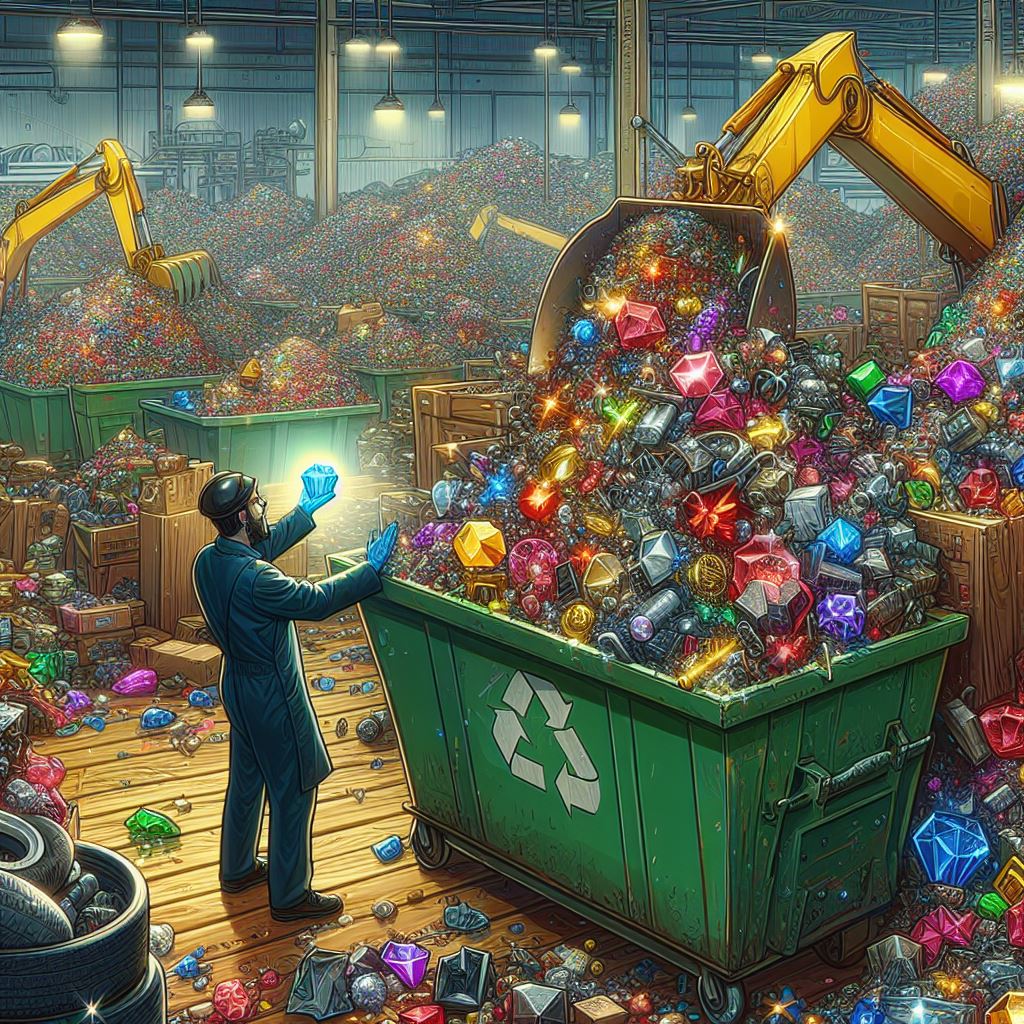
Best case it’s finding gems among more gems…
…worst case it’s some Kafkaesque fever dream

(“Tire Fire” or “garbage dump” are common epithets most mature, enterprise systems like Jira are described as by Creators and Seekers – except in the rare cases where the system is zealously, jealously locked down and heavily demanding on any input by the griping Creators.)

In our use of Productboard and Jira (or any other tool for grappling the feedback tsunami) we’re in the position most of my friends and colleagues across the industry find themselves – doing a decent job finding individual items, mostly good at having them categorised for most Seekers’ daily needs, and wondering if there’s a better a technology solution to a people & process problem.

(Hint: there aren’t.)

Curation is the price we need to pay to make easy inputs turn into effective outputs. Penance for most of us who’ve been around long enough to complain how badly organised things are, and who eventually recognise that we need to be the change we seek in the world.

“You either die a hero or live long enough to become the villain.” — Harvey Dent

Feature Request is a curse word

“Feature Request” is one of my favourite rant inspirers of late.

Not that there aren’t plenty of good features/ideas/problems-to-be-solved that are suggested by customers, partners and colleagues.

But that it’s so hard to find the real gems in a pile of hay, and too much of what gets filed are “solutions with no clear problem statement”.

Why do I get so invested in this process? Customer has a problem, they’ve figured out a great way that would totally solve their problem, and now it’s just their challenge of coercing the vendor until they finally gets around to delivering it. Usually later than you wanted, and not like what you asked for, and couched in go-to-market-friendly language that makes for a fun guessing-game of “does this solve the problem I needed addressed?”

This dysfunctional interaction wastes a whole lot of execution and onboarding time. Why don’t we do it better up front?

Here’s my experience, after doing product work in four separate tech companies, where I’ve been focusing on building user- and developer-productivity features of existing platforms that are intended to retain satisfied customers for years:

  • “feature requests” are often one-liner, “obvious” statements of something the customer is frankly frustrated we hadn’t already done – e.g. “add these three fields to the search API” – with no context why this isn’t simply a nice-to-have that someone heard and repeated up the channel, leaving us to over-pivot on low-priority items or assume that all such uncontextualised requests are likely low-pri noise.
  • They’re a request for a big-F Feature – which is a solution to an implicit problem (e.g. “We need executive reporting”) – not a Job, or a gap, or an unmet Decision, any spin of which are much more oriented around problems to be solved (e.g. “I need to produce a monthly report for our CISO of unique malware found, to justify the monthly subscription cost to the Finance department”)
  • They often assume a particular implementation and don’t tell us why other alternatives (that could well achieve the same outcome) are inferior – e.g. request comes in of the form “I need to export our threat intel feeds from this page”, when we have a very simple SDK that already has example scripts for doing just that. That there are gaps between one implementation and another are natural; the important bit is in how much unworkable friction the alternatives introduce.
  • There’s no believable way from the telephone game of distilled need to gauge how critical this need is – and since you all know vendors are slow to respond, you must assume that we’ll only respond to emergencies and so you’ll characterise the request as a “P0” even if there’s no rush and no critical impact from its absence

By calling this artifact of indirect communication (from customer to “decison makers who can and might decide to insert this into planned execution”) a Feature Request instead of a Problem Statement or a Proposal For Discussion, it assumes this is the end of communication, there’s no need for further background or context, and that the fastest way to get the vendor to fix the problem is to boil it down to “what the solution looks like”.

It absolutely assumes and encourages “tell the vendor what to implement” rather than “tell them what problem you’re having, what decision or action you’re unable to achieve without a solution to this problem, and how this will significantly impact your business operations”.

Why is it even called a feature request? When did we start asking our customers what to build, rather than asking our customers what problems they have, and helping them find solutions? It’s especially important in our line of work, as curators between market and engineering, to find common problems across customers and market segments, and help engineers address those pain points to make customers delighted, productive and loyal.

These days I make an effort to engage with any feature request that isn’t (a) already aligned to solidly-planned enhancements and (b) isn’t clearly spelled out why this matters to the customer. Our “feature request” systems aren’t great for even indirect communication with the originating customer, so many of these conversations get delayed for months if ever. I’ll increasingly root around Salesforce and Slack to reach out to associated Success Manager or Solution Engineer, but that’s still lacking the fidelity of the direct conversation with the person-with-the-problem. It’s a journey.

So if you see me try to stifle rolling my eyes the next time you ask me for the likelihood I’ll deliver this customer’s quick Feature Request, please assume it’s nothing personal – and that I’m very amenable to conversations that increase the likelihood we’ll address the problem.

DevOps status report: HackOregon 2019 season

One of my colleagues on the HackOregon project this year sent around “Nice post on infrastructure as code and what getting solid infra deploys in place can unlock” https://www.honeycomb.io/blog/treading-in-haunted-graveyards/

I felt immediately compelled to respond, saying:

Provocative thinking, and we are well on our way I’d say.

I’ve been the DevOps lead for HackOregon for three years now, and more often than not delivering 80% of the infrastructure each year – the CI/CD pipeline, the automation scripts for standardizing and migrating configuration and data into the AWS layers, and the troubleshooting and white-glove onboarding of each project’s teams where they touch the AWS infrastructure.

There’s great people to work with too – on the occasions when they’ve got the bandwidth to help debug some nasty problem, or see what I’ve been too bleary-eyed to notice is getting in our way, it’s been gratifying to pair up and work these challenges through to a workable (if not always elegant) solution.

My two most important guiding principles on this project have been:

  • Get project developers productive as soon as possible – ensure they have a Continuous Deployment pipeline that gets their project into the cloud, and allows them to see that it works so they can quickly see when a future commit breaks it
  • “working > good > fast” – get something working first, make it “good” (remove the hard-coding, the quick workarounds) second, then make it automated, reusable and documented

We’re married pretty solidly to the AWS platform, and to a CloudFormation-based orchestration model.  It’s evolved (slowly) over the years, as we’ve introspected the AWS Labs EC2 reference architecture, and as I’ve pulled apart the pieces of that stack one by one and repurposed that architecture to our needs.

Getting our CloudFormation templates to a place where we can launch an entirely separate test instance of the whole stack was a huge step forward from “welp, we always gotta debug in prod”. That goal was met about a month ago, and the stack went from “mysterious and murky” to “tractably refactorable and extensible”.

Stage two was digging deep enough into the graveyard to understand how the ECS parts fit together, so that we could swap EC2 for Fargate on a container-by-container basis. That was a painful transition but ultimately paid off – we’re well on our way, and can now add containerised tasks without also having to juggle a whole lot of maintenance of the EC2 boxes that are a velocity-sapping drag on our progress.

Stage 3 has been refactoring our ECS service templates into a standardised single template used by whole families of containerised tasks, from a spray of copypasta hard-coded replicas that (a) had to be curated by hand (much like our previous years’ containerised APIs has to be maintained one at a time), and (b) buried the lede on what unique configuration was being used in each service. Any of the goofy bits you need to know ahead of deploying the next container are now obvious and all in one place, the single master.yaml.

I can’t speak for everyone, but I’ve been pretty slavish about pushing all CF changes to the repo in branches and merging when the next round of stable/working infra has been reached. There’s always room for improvement, however:

  • smaller changes are always better
  • we could afford more folks who are trained and comfortable with the complex orchestration embedded in our infrastructure-as-code
  • which would mean being able to conduct good reviews before merge-to-master
  • I’d be interested in how we can automate the validation of commit-timed-upgrades (though that would require more than a single mixed-use environment).

Next up for us are tasks like:

  • refactoring all the containers into a separate stack (out of master.yaml)
  • parameterising the domains used for ALB routing
  • separating production assets from the development/staging environment
  • separating a core infra layer from the staging vs production side-by-side assets
  • refactoring the IAM provisions in our deployment (policies and attached roles)
  • pulling in more of the coupled resources such as DNS, certs and RDS into the orchestration source-controlled code
  • monitoring and alerting for real-time application health (not just infra-delivery health)
  • deploying *versioned* assets (not just :latest which becomes hard to trace backwards) automatically and version-locking the known-good production configuration each time it stabilises
  • upgrading all the 2017 and 2018 APIs to current deployment compatibility (looking for help here!)
  • assessing orchestration tech to address gaps or limitations in our current tools (e.g. YAML vs. JSON or TOML, pre-deploy validation, CF-vs.-terraform-vs-Kubernetes)
  • better use of tagging?
  • more use of delegated IAM permissions to certain pieces of the infra?

This snapshot of where we’re at doesn’t capture the full journey of all the late nights, painful rabbit holes and miraculous epiphanies

Mike, what books do you suggest for getting up to speed on the Lean approach?

Recent question to me from a newbie to my Lean Coffee meetup:

Hey, I was wondering if you could suggest any books for getting up to speed on the LEAN approach? I’m reading ‘The Lean Startup’ by Eric Ries, and like it a lot. Anything that you’ve really enjoyed? Thanks 🙂

Thought I’d share he thoughts I passed to David:

Hi David, I’m not much of a prose guy – unconferences, meet-ups, lean coffee and experiential training work better for me. I’ve skimmed Lean Startup and that was interesting in parts; I’ve also read the Phoenix Project (devops focus and pretty terrible plotting and characters but a weirdly compelling outlook on incremental, value-based organisations – and it’s apparently a rewrite of the plot of The Goal which I’ve heard is also good in this vein).

Neal Peterson (who’s a regular attendee and runs a parallel Lean Coffee of the North) is our resident Lean Guru. I’d reach out to him too.

If you haven’t already, I’d strongly recommend getting involved with Agile PDX – many meet-up opportunities each month, and an invite-only (only because we haven’t automated self-signup) Slack group you’d be welcome to join.

Occupied Neurons, Santa edition: lessons for software engineering

How to Be An Insanely Successful Software Manager

https://hackernoon.com/how-to-be-an-insanely-successful-software-manager-13efe08fd890

Aside from a few dubious quotes and phrasings, I believe someone channeled my life when they wrote this.  (Is that why I smelled burning sulfur recently?)  When the goal of a software org is getting the most value into customers hands as quickly as possible, shaving down every point of friction between “User Story” and “running in production” is an obsessive mission.

No one does phrasing better than Sterling Archer

Benefit vs Cost: How to Prioritize Your Product Roadmap

https://www.productplan.com/how-to-prioritize-product-roadmap/

I’ve been a data-driven, quantitative prioritization junkie in my Product work for years. When you want to have a repeatable, defensible, consensus-able (?) way for everyone to see what are the most valuable items in your Backlog, you ought to invest in a way to estimate Business Value just as much as you need the engineering team to estimate Effort.  Makes planning and communicating much easier in the long run.

Specific methodologies are a reflection of the rigour and particular characteristics an organization derives value for its customers and shareholders.  A heavily regulated industry might use “Regulatory Compliance” as a double-weighted factor in their ‘algorithm’; an internal IT team might focus .   Many teams put emphasis on Estimated Revenue Impact and Reducing Customer Churn, and I’ve personally ensured that UX (“Expected Frustration Reduction”) has a place at the table.  Numeric scales, “high-medium-low”, “S-M-L-XL” or “Y/N” can all factor in, to whatever degree of rigour is necessary to sufficiently order and prioritize your backlog – don’t overengineer a system when half as much effort will get a useful starting place for the final “sorting negotiation” among stakeholders.


Introduction to ES6 Promises

http://jamesknelson.com/grokking-es6-promises-the-four-functions-you-need-to-avoid-callback-hell/

Been hearing about Promises and async/await from my engineering colleagues for ages.  Conceptually they’re a great advancement – making code more efficient, reflecting the unpredictable nature of distributed software systems, breaking the serialization bias of every new programmer yet again.

However, the truth of implementing Promises, for those who have never wrangled such code, is far more complex than I expected.  Just reading the explanations by accomplished programmers, with all their multi-layered assumptions and skipping-ahead-without-clarification, makes me feel dense in a way that doesn’t have to be true.  I’m sure if every element of the canonical use of a Promise object was explained (where it’s used, in what order, by what consumer), it would be much easier to get it to work.  I’ll keep hunting for that pedagogical example.

GraphQL vs REST Overview

https://philsturgeon.uk/api/2017/01/24/graphql-vs-rest-overview/

I’m hearing a lot of developers extoll the virtues of GraphQL in their side projects (and professional work, where they have room to advocate up).  I haven’t managed a Product shipping GraphQL services yet, so I’ve been curious what the folks already implementing these are learning.

One problem this article highlights is “deprecation” – when is it time to no longer support a field or endpoint in your API?  The latter is easy to see how many requests you’re currently receiving; the former is trickier in a REST environment, and GraphQL supports “sparse field sets”.

The question I don’t see addressed here is: does GraphQL require every request to specify every field they’re going to obtain?  Or is there also support to request all fields (cf. SELECT * from TABLE), in which case that benefit quickly vanishes?  If only some of your requests specify which fields they’re using, and the rest just demand them all, then you still don’t know whether that field you want to depreciate is up for grabs, nor which users are still using it.  You can infer some educated guesses based on the data you do have, but it’s still down to guesswork.

(Edit: I’ve concluded that fields must be explicit in GraphQL requests)

REST is the New SOAP

https://medium.com/@pakaldebonchamp/rest-is-the-new-soap-97ff6c09896d

OK OK I get it – REST is challenging in many ways when trying to deal with the reality of API behaviours.  Thank you for writing an article that outlines in specific what your problems are.  (OTOH, wouldn’t it be nice to see an article that acknowledges the problems *and* extolls the remaining virtues – see author’s own words, “I don’t doubt that some smart people out there will provide cases where REST shines”?  Or even better, talks about when to use this solution and when to use a solution that works better for a specified scenario/architecture – and not just offhandedly mention something they “heard that one time”?)

And why do I have that itchy feeling in the back of my brain that newer alternatives like GraphQL will put us in a state of complexity that we ran from the last time we did this to ourselves in the name of “giving ourselves all the tools we might ever need” (aka SOAP)?

It’s smart to select a relevant architecture for the problem space – it just makes me worry every time I watch someone put in place all sorts of “just in case” features that they have no need for now – and can’t even articulate a specific problem for which this is a great solution – but are sure there’ll be some use for in the future.  I haven’t delved deeply enough into GraphQL (obviously) but my glancing analysis made it seem much more flexible – and the last time I saw “eminently flexible” was when I saw OAuth 2 described to me as “puts all the grenades you’ll ever need in your hands and pulls the pins”.

Kitty Quinn captures my unease very well here, and quotes Allen Sherman to boot:

‘Cause they promise me miracles, magic, and hope,
But, somehow, it always turns out to be SOAP

Linus rants at the security community again – bravo

https://lkml.org/lkml/2017/11/17/767

Linus goes off on the security community who keep trying to make sweeping, under-tested, destabilizing changes to the kernel, and while his delivery leaves something to be desired, the message is welcome and apparently remains necessary.  Making radical changes that do nothing to help the system operators and users know what’s going on, or be able to control or even just report the issues, is shall we say frustrating.

keep-calm-and-burn-it-down-5

It’s this kind of flagrant power play by security mavens that irks the rest of us to homicidal degree. It punishes the user in the hopes that that user will push the pain uphill to the originator of the buggy code.

Except that no typical user (i.e. 99% of the computing end user population) even *recognises* that the problem is with the calling code (app, driver) rather than the OS (“computer”, “CPU”, “crap phone”) that is merely trained to enforce these extreme behaviours.

I find after a couple of decades in infosec land that this is motivated by the disregard security folks have for the end user victims of this whole tug-of-war, which seems so often to break down to “I’m sick of chasing software developers to convince them to fix their bugs, so instead let’s make the bug ‘obvious’ to the end users and then the users will chase down the software developers for me”.

Immediate kernel panic may have been an appropriate response decades ago when operators, programmers and users were closely tied in space and culture. It may even still be an appropriate posture for some mission-critical and highly-sensitive systems, if you favour “protection” over stability.

It is increasingly ridiculous for the user of most other systems to have any idea how to communicate with the powers that be what happened and have that turned into a fix in a viable timeframe – let alone rely on instrumented, aggregated, anonymized crash reports be fed en masse to the few vendors who know let alone have the time to request, retrieve and paw through millions of such reports looking for the few needles in haystacks.

Punish the victim and offload the *real* work of security (i.e. getting bugs fixed) to people least interested and least expert at it? Yeah, good luck.

It is entirely appropriate in an increasing number of circumstances to soften the approach and try warning the user and trusting them with a little power to make some decisions themselves (rather than arbitrarily punish them for mistakes not their own).

I love many of my colleagues in the security community dearly, and wouldn’t tell them to quit their jobs, but goddamn do we quickly forget that the options are not just “PREVENT” but also “DETECT” and “CORRECT”. I’m glad to see that Kees Cook’s followup clarifies that he’s already looking into this, and learning that such violent change to a kernel can’t be swallowed whole.

When will DevSecOps resemble DevOps?

https://www-forbes-com.cdn.ampproject.org/c/s/www.forbes.com/sites/jasonbloomberg/2017/11/20/mitigate-digital-transformation-cybersecurity-risk-with-devsecops/amp/

Another substance-free treatise on the glories of DevSecOps.

“Security is everyone’s job”, “everyone should care about security” and “we can’t just automate this job” seems to be the standard mantra, a decade on.

Which is entirely frustrating to those of us who are tired of security people pointing out the problems and then running as soon as there’s talk of the backbreaking labour of actually fixing the security issues, let alone making substantive system improvements that reduce their frequency in the future.

Hell, we even get a subheading that implies it’ll advance security goals in a CI/CD world: “The Role of Tooling in DevSecOps”. Except that there’s nothing more than a passing wave hello to Coverity (a decent static analysis vendor, but not the start nor the finish of the problem space) and more talk of people & process.

Where’s the leading thinkers on secure configuration of your containers? Where’s the automated injection of tools that can enforce good security IAM and correct for the bad?

I am very tired of chasing Lucy’s football:

lucy-football

I’m tired of going out to DevSecOps discussions at meetups and conferences and hearing nothing that sounds like they “get” DevOps.

DevOps works in service of the customers, developers and the business in helping to streamline, reduce the friction of release and make it possible to get small chances out as fast and frequently as possible.

I’ve asked at each of those discussions, “What tools and automation can you recommend that gets security integrated into the CI/CD chain?”

And I’ve heard a number of unsatisfying answers, from “security is everyone’s job and they should be considering it before their code gets committed” all the way through to “we can’t talk about tools until we get the culture right”. Which are all just tap-dancing dodges around the basic principle: the emperor has no clothes.

If DevSecOps is nothing more than “fobbing the job off on developers” and “we don’t recommend or implement any tools in the CI/CD chain”, then you have no business jumping on the DevOps bandwagon as if you’re actively participating in the process.

If you’re reliant merely on the humans (not the technology) to improve security, and further that you’re pushing the problem onto the people *least* expert in the problem space, how can you possibly expect to help the business *accelerate* their results?

Yes I get that DevOps is more than merely tools, but if you believe Gene Kim (as I’m willing to do), it’s about three principles for which tools are an essential component:

  1. Flow (reduce the friction of delivery) and systems thinking (not kicking the can down to some other poor soul)
  2. Amplify feedback loops (make it easy and obvious to learn from mistakes)
  3. Create a culture of learning from failure.

Now, which of those does your infosec approach support?

Hell, tell me I’m wrong and you’ve got a stack of tooling integrated into your DevOps pipeline. Tell me what kinds of tools/scripts/immutable infrastructure you’ve got in that stack. I will kiss your feet to find out what the rest of us are missing!

Edit: thoughts

  • Obviously I’m glossing over some basic tools everyone should be using: linters.  Not that your out-of-the-box linter is going to directly catch any significant security issues, no – but that if you don’t even have your code following good coding standards, how the hell will your senior developers have the attention and stamina to perform high-quality, rapid code reviews when they’re getting distracted by off-pattern code constructions?
  • Further, all decent linters will accept custom rules, disabled/info-only settings to existing rules – giving you the ability to converge on an accepted baseline that all developers can agree to follow, and then slowly expand the footprint of those rules as the obvious issues get taken care of in early rounds.
  • Oh, and I stumbled across the DevSecCon series, where there are likely a number of tantalizing tidbits

Edit: found one!

Here’s a CI-friendly tool: Peach API Security

  • Good news: built to integrate directly into the DevOps CI pipeline, testing the OWASP Top Ten against your API.
  • Bad news: I’d love to report something good about it, but the evaluation experience is frustratingly disjointed and incomplete.  I’m guessing they don’t have a Product Manager on the job, because there are a lot of missing pieces in the sales-evaluation-and-adoption pipeline:
    • Product Details are hosted in a PDF file (rather than online, as is customary today), linked as “How to Download” but titled “How to Purchase”
    • Most “hyperlinks” in the PDF are non-functional
    • Confusing user flow to get to additional info – “Learn More” next to “How to Download” leads to a Data Sheet, the footer includes a generic “Datasheets” link that leads to a jumbled mass over overly-whitespaced links to additional documents on everything from “competitive cheatsheets” to “(randomly-selected-)industry-specific discussion” to “list of available test modules”
    • Documents have no common look-and-feel, layout, topic flow or art/branding identity (almost as if they’re generated by individuals who have no central coordination)
    • There are no browseable/downloadable evaluation guides to explain how the product works, how to configure it, what commands to use to integrate it into the various CI pipelines, how to read the output, example scripts to parse and alert on the output – lacking this, I can’t gain confidence that this tool is ready for production usage
    • No running/interrogable sample by which to observe the live behaviour (e.g. an AWS instance running against a series of APIs, whose code is hosted in public GitHub repos)
  • I know the guys at Deja Vu are better than this – their security consulting services are awesome – so I’m mystified why Peach Tech seems the forgotten stepchild.

Edit: found another!

Neuvector is fielding a “continuous container security” commercial tool.  This article is what tipped me off about them, and it happens to mention a couple of non-commercial ideas for container security that are worth checking out as well:

Edit: and an open source tool!

Zed Attack Proxy (ZAProxy), coordinated by OWASP, and hosted on github.  Many automatable, scripted capabilities to search for security vulnerabilities in your web applications.


Occupied Neurons, November Kunst

What Trader Joes Figured Out About Work Culture That My Other Past Employers Haven’t

http://engage.guidespark.com/talent-and-culture/what-trader-joes-figured-out-about-work-culture-that-my-other-past-employers-havent/

Holy shit folks, I could study this like the Torah for the rest of my professional life.  Open every conversation with open-ended question?  “There’s 1000 ways to do it right”?  Yes yes and yes.

Saving The World From Code

https://www.theatlantic.com/technology/archive/2017/09/saving-the-world-from-code/540393/

One of the most frustrating things for me, a part-time coder, is having so much difficulty following the state of things as expressed in semi-linear Code (don’t even get me started with Functional and async). When I’m trying to piece together code fragments from multiple sources, it’s nearly impossible for me to reason the complete working model – I end up writing out a stepwise process model, or changing variable names one at a time and iterating forever until I see which piece contributes what to the whole machine.

So this piece – and the underlying theme of “software is beyond the reasoning capacity of great humans” – resonates like hell for me.

Uncle Bob and Silver Bullets

https://www.hillelwayne.com/post/uncle-bob/

There’s only so much “blame the victim” I can stand in this world, and Uncle Bob is one of the loudest offenders. Yeah we should all get better at coding, and yeah we should hold ourselves accountable when it doesn’t measure up.

But what about the interim? How’s about standing on the shoulders of giants? Or leaning on our elders? Or centralising expertise and leaving others to be good at what they’re good at?

I’m all for not being expected to master the universe before getting on with the job of getting something out into the world to learn from it. If everyone waited until they were the best at every discipline involved in the making of things…well, you can imagine how bereft the world would be.

It’s actually a good reminder to dial back the damned voice in my (and your) head telling us we’re not good enough yet. Let’s make something useful, and find out how wrong we are in someone else’s eyes, by encountering the actual evidence of feedback.

What’s the Difference between JavaScript and ECMAScript?

When Do I Know I’m Ready for Redux?

https://medium.com/dailyjs/when-do-i-know-im-ready-for-redux-f34da253c85f

One of many think-pieces about whether and when to add Redux to a React.js app, and a helpful guide for those not already steeped in the experience of doing so.

Understanding ReactJS-Component life cycle

https://medium.com/@baphemot/understanding-reactjs-component-life-cycle-823a640b3e8d

Far too abstract for a non-expert to follow – this is a documentation piece, and not even a good one at that. Re-examine this in a year, maybe it’ll make sense by then. Experts only.

Presentational and Container Components

https://medium.com/@dan_abramov/smart-and-dumb-components-7ca2f9a7c7d0

An interesting pattern to note for later, when the app I’m working on scales to the point I find myself passing props through component layers.

Optimizing React Rendering (part 1)

https://flexport.engineering/optimizing-react-rendering-part-1-9634469dca02

Optimizing?  Bah – definitely too early for optimization in my app.  Got one page working.  Let’s leave this as a breadcrumb for future Mike.

Javascript Arrow Functions for Beginners

https://codeburst.io/javascript-arrow-functions-for-beginners-926947fc0cdc

I’ll re-read this until it sinks in.  Lambda notation mystifies me, but probably I just need to implement it a hundred times or so and my brain will settle down.